History
ARCHITECTURE AND SPACES
Originally known as the Nuovo Teatro Ducale, the Teatro Regio di Parma was founded at the behest of Duchess Marie Louise of Habsburg-Lorraine, Napoleon’s wife, who was sent to rule the Duchy of Parma, Piacenza and Guastalla following the Congress of Vienna. Work began in 1821 based on a design by the court architect Nicola Bettoli, and the theatre opened on 16 May 1829 with Zaira, an opera by Vincenzo Bellini with a libretto by Felice Romani.
Built in the Neoclassical style, the façade is characterised by an Ionic colonnade and a large arched window at the top. Beyond the entrance hall lies the Foyer, flanked by two rows of four columns; on the floor, one can see the trapdoors through which the heating was distributed. A staircase leads to the Ridotto Hall, where Marie Louise’s throne once stood; she could access it directly from the rooms of the Ducal Palace. Two blown-glass chandeliers hang from the painted vaulted ceiling, and above them are the women’s galleries that once housed the dance orchestras. Returning to the foyer and passing through the main entrance, one enters the heart of the building: the hall, with the stalls, four tiers of boxes and the gallery, is surmounted by the ceiling painted by Giovan Battista Borghesi, in which poets and playwrights are arranged in a circle around the ‘astrolampo’, the large gilded bronze chandelier forged by the Lacarrière workshops in Paris. The painted curtain, one of the few examples to have survived to the present day, is also the work of Borghesi: a crowded allegory of Wisdom, with Minerva seated on a throne surrounded by gods, nymphs, poets and muses, features, in the guise of the goddess, a portrait of Marie Louise.
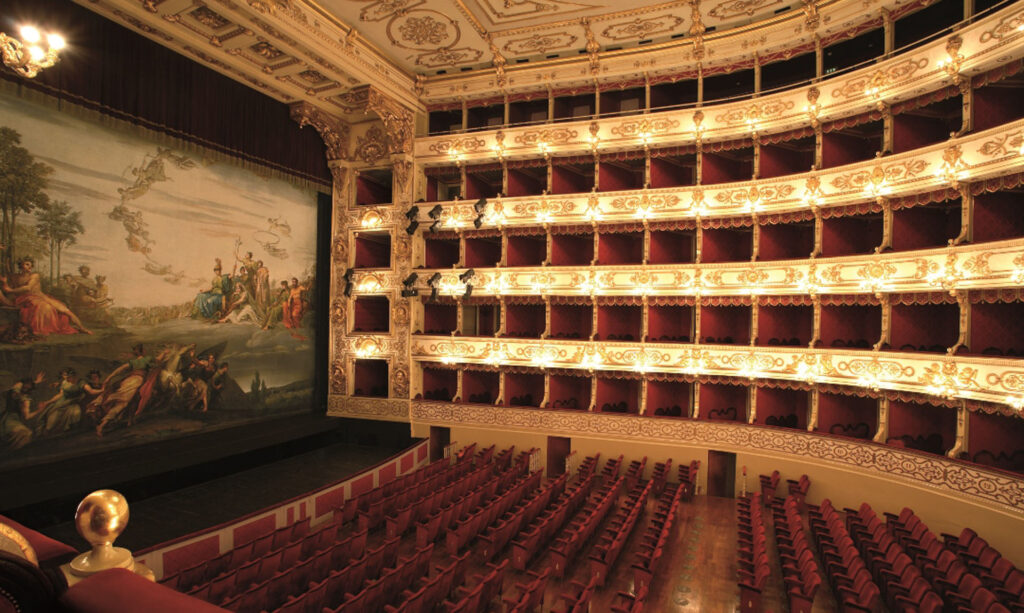
At the top, a ‘light’ clock, which strikes the hour every five minutes, is positioned at the centre of the proscenium arch, adorned with gilded busts of poets and composers. The appearance of the auditorium today is very different from the original: in 1853, the Neoclassical décor, designed by Paolo Toschi, was adorned with stucco work and gilding by Girolamo Magnani (a decorator whom Verdi often sought to have at his side as a set designer) who, commissioned by Charles III of Bourbon, renovated the façade of what was by then the Teatro Regio in the Neo-Renaissance style. In the same year, the new chandelier – scaled down in 1913 to improve visibility from the gallery – inaugurated the gas lighting system, which replaced the old system of candles and oil lamps, whilst electric lighting was introduced in 1890.
The acoustic chamber, painted by Giuseppe Carmignani, is one of the few examples to have survived the ravages of time and wear and tear; it echoes the décor of the boxes and consists of hemp panels mounted on wooden frames, which can be telescopically adjusted to accommodate a wide variety of orchestral formations. Originally, the theatre was designed to host a wide variety of performances, from opera to dance, from poetry recitals to the most diverse forms of ‘variety arts’ (tightrope walking and gymnastic displays, acts with trained animals, scientific demonstrations, magic, and exhibitions of ‘curiosities’). Since its inauguration, it has been both a witness to and a key player in the crucial changes that swept through opera during the nineteenth century and the following century, from the end of the era associated with Rossini to the dominance of Verdi’s repertoire, from its openness to French and German influences to the radical shift towards realism in Italian opera with Mascagni, Leoncavallo and Puccini.
BORGHESI CURTAIN
This work by Giovan Battista Borghesi (Parma 1790–1846) depicts an allegorical scene divided into three parts.
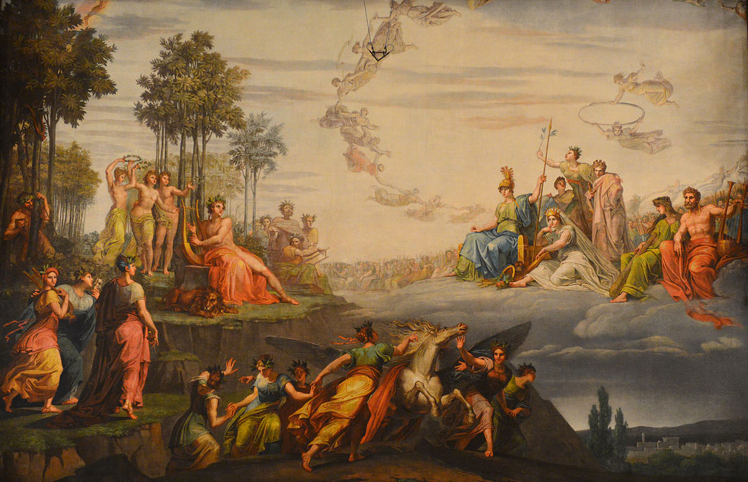
On the right, Marie Louise is depicted as Minerva, seated on a throne with the symbols of her power: the plumed helmet, the cloak and the sceptre. At her feet lies the owl, sacred to the goddess, and to the right a nymph gazes at the shield lying on the ground, a symbol of peace. Behind her, one can see the allegories of Abundance, Justice and Peace. Nearby are Hercules and Deianira, whilst above them, in an unbroken circle, the hours are depicted, a symbol of the eternity of time. Behind the Goddess, human figures can be seen playing the lyre, representing subjects dear to the Duchess, a lover of music and song. To the left of the painting, the heights of Parnassus are populated by deities and spirits. Apollo, in the centre, is playing the lyre, and at his feet lies a lion lulled by the divine music. Further on are the Graces, and near the grove of trees stand the poets Pindar, Homer, Virgil, Ovid and Dante.
To Apollo’s left are three muses: Thalia, who represents comedy and wears a mask; Melpomene, the muse of tragedy, who carries a dagger; and Euterpe, the muse of music, who carries a lyre on her shoulder. Hidden behind a tree, looking almost menacing and clutching his flutes, is Marsyas, defeated by Apollo in a musical contest. At the centre of the scene, striving to be freed by the Muses, is Pegasus, the winged horse born from Medusa’s blood, who with a mighty kick freed wisdom and poetry from the rock. It is as though Pegasus were advancing towards the spectators, bringing his gift to humanity once more.
THE PAINTER
Giovan Battista Borghesi (Parma 1790 – 1846) studied in Parma at the school of Biagio Martini. Around 1815, he painted Homer, illustrating the Iliad in various rooms of the Ducal Palace in Colorno. He painted many works for the churches of Parma: in 1823, the altarpiece for the Oratorio dei Rossi was awarded a ducal grant which enabled him to travel to Rome where, over the course of two years, he painted a number of stage sets for the Teatro Argentina. On his return to Parma, he stopped off in Perugia and Florence where, among other things and drawing inspiration from similar works by Raphael and Sustermans, he painted portraits of La Fornarina and Galileo. On his return to Parma in 1830, he was appointed professor of painting at the Academy of Fine Arts. He restored Parmigianino’s frescoes at Fontanellato and then painted what are considered his masterpieces: the portrait of Marie Louise, which is now in the National Gallery of Parma; the ceiling and the curtain of the Teatro Regio; and the ceiling of the third room of the Palatine Library.
Sipario d’artista – Mimmo Paladino
Almost 200 years after its construction, the Teatro Regio in Parma has a new curtain, designed by Mimmo Paladino and crafted at the Teatro Regio’s stage design workshops, as part of a special project by the Reggio Parma Festival, realised with the support of Barilla.
The new curtain of the Teatro Regio di Parma was unveiled as part of the 21st Verdi Festival on the day marking the 208th anniversary of Giuseppe Verdi’s birth, during a ceremony that opened the traditional Verdi Gala, and will hang alongside the historic curtain designed in neoclassical style by Giovan Battista Borghesi in 1829.
The unveiling of the curtain was entrusted to a project by visual artist Paolo Ferrari C999, who, drawing inspiration from the work of Mimmo Paladino, wove a narrative by connecting the opera with the languages of new media.
“The creation of a new curtain for the Teatro Regio, curated by Mimmo Paladino as a Special Project of the RPF Association, together with the metal portal that the same artist from Campania designed for the proscenium of the Arena Shakespeare at the Teatro Due, represents an important milestone in this journey: a tangible sign of the shared desire to create a union, on the occasion of Parma 2020, between theatrical events and the visual arts of our time”, states Luigi Ferrari, President of the Reggio Parma Festival Association. “The idea arose from the desire to offer the public, alongside the inherently ephemeral nature of live performances, a work destined to endure over time, capable of leaving a lasting impression on the eyes and minds of those who, in the days, months and years to come, will be able to admire a curtain not intended to replace the historic one currently in use, but to alternate with it, in a continuous and evocative interplay between voices of the past and the realities of the present.”
Giuseppe Verdi’s music served as the inspiration for the creation of the work: “There is perhaps, in this curtain, a hidden dedication: we are in Giuseppe Verdi’s homeland and, naturally, his music was the source of inspiration, leading me to conceive of a sort of chromatic symphony of figurative fragments. It is not an explicit dedication, but Verdi’s music was the starting point,” says the artist Mimmo Paladino in a conversation curated by Federico Giannini, who highlights the significance of the time spent on the work’s development and the message underpinning it: “This chromatic explosion can be a sign of positivity. After a tragedy, after a situation like the one we have experienced, there is always a desire to think of something that brings happiness based on the joy of expression, in this case of colour. And so perhaps this explosion of bright colours is also a result of this historic moment. A meaning that is, in some ways, unconscious, but which emerges powerfully as a desire to return to the theatre.” The work of the theatre’s technical workshops, led by Franco Venturi, has been fundamental: “To create this curtain,” continues Mimmo Paladino, “I was able to count on the invaluable collaboration of the set designers at the Teatro Regio who, in a way, were my arms and my hands and, drawing on their experience, often advised me and helped me find solutions to the problems I had to tackle.”
“A threshold to cross. A veil to lift. A curtain to part in order to go further, deeper. Almost 200 years after its construction, the Teatro Regio di Parma is enriched with a new curtain,” declares Anna Maria Meo, General Manager of the Teatro Regio di Parma – “adding a prestigious touch to its first bicentenary, combining the neoclassical brushstrokes of Giovan Battista Borghesi’s sumptuous historic curtain with the geometries and brilliant colours of Mimmo Paladino. History and Tradition. Contemporaneity and Future. To renew the memory of a ritual that takes us back to the roots of theatre and music and which continues to challenge us and help us grow as a community. A new curtain conceived and created in this third millennium in the stage design workshops of the Teatro Regio di Parma, where Mimmo Paladino’s vision unfolded on the canvas prepared to receive the drawings, the silhouettes, panels which, in a rapid process spanning just a few lunar cycles, took shape and colour through the mastery of Franco Venturi and his collaborators, who supported the artist in the process of reflection and creation of a monumental and complex artefact. A new present marking the beginning of a new future. Today. Now.”
The project is one of the initiatives that have made Parma the Italian Capital of Culture, home to a theatre which, without compromising its identity, has become a champion of experimentation and research: “a curtain that does not replace that of the Borghesi, but stands alongside it, marking a new and different threshold between what the stage conceals and the audience, signifying an entrance and a passage that the Theatre, with foresight and passion, feels it must take responsibility for, in a historical period that poses to those working in these fields the great – and at times daunting – question of the future of the audience,” says Michele Guerra, Councillor for Culture of the Municipality of Parma.
THE ACOUSTIC CHAMBER
Painted by Giuseppe Carmignani (1871–1943), the room is composed of panels of various shapes and sizes, covering a total area of 320 square metres.
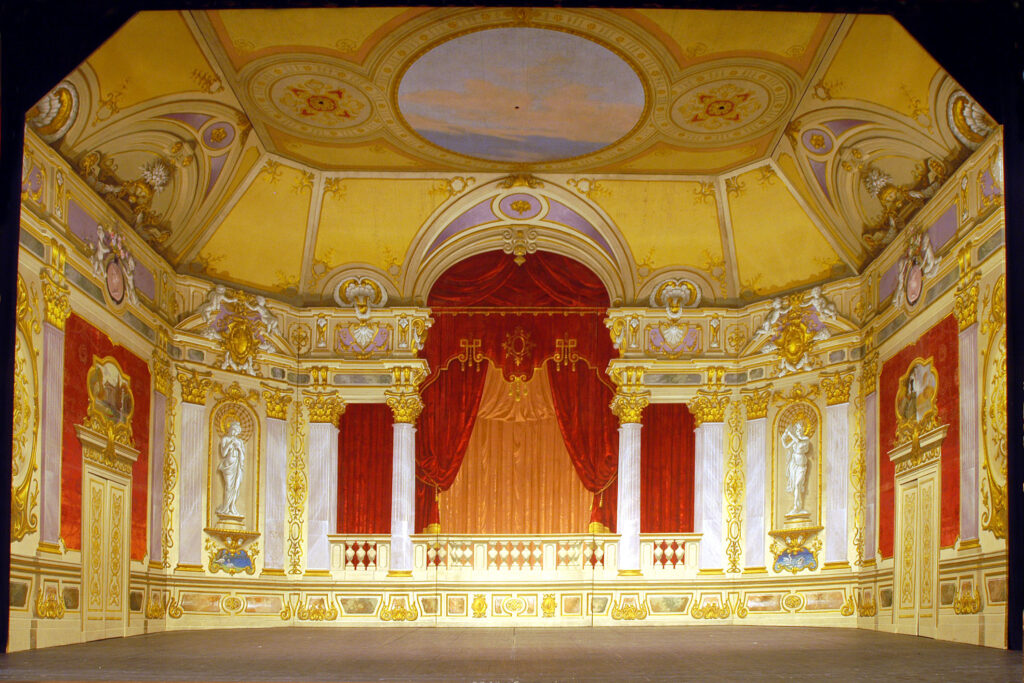
The canvas panels are mounted on wood and can be assembled to form orchestra boxes of various sizes. The painting reproduces stucco and inlay elements used in the decoration of the boxes in the theatre and was executed in tempera using powdered pigments bound with animal glue. The painting was executed directly onto the canvas without a preparatory layer, which would normally have been made with chalk and animal glue, in order to preserve the lightweight nature of the panels.
THE PAINTER
Giuseppe Carmignani studied at the Academy of Fine Arts in Parma under Gerolamo Magnani and Giuseppe Giacopelli. After working at the Teatro Regio in 1893, he worked at La Scala in Milan before moving to Argentina, where he designed sets for all the state theatres. In 1898, he was appointed lecturer in perspective at the National Academy of Fine Arts and, the following year, in decorative arts at the University of Buenos Aires. In 1911, he returned to Parma and, the following year, took up the chair of decorative arts at the Institute of Fine Arts, later becoming director and lecturer in set design, based in the attic of the Teatro Regio.
THE LIGHT CLOCK
Time regained, an essay by Giuseppe Martini to mark the restoration of the antique clock crafted by Paolo Valenti.
È un frangente fulmineo eppure lentissimo, che si apparenta a qualcosa di cosmico, a un farsi strada in uno spazio indefinito e dilazionato, popolato di suoni arcani e luci distanti. Ci si riscuote da un tempo irreale, che è il tempo sospeso del palcoscenico, misurato da arie e cori, da spade sguainate e maledizioni, e si rientra per un frammento di esistenza nel tempo della vita comune, quello sul quale là fuori si confrontano le ripartenze degli autobus e le saracinesche che si abbassano. A quel punto lo spettatore bene educato del teatro, e diciamo del Teatro Regio di Parma, si rivolge all’orologio sopra l’architrave del palcoscenico. Nulla di appariscente: basta un colpo d’occhio per incontrare le aggraziate cifre che, discrete ma nette, si fanno improvvisamente largo alla vista, come se fino a quel momento non ci fossero mai state. Lo spettatore ben educato sa riconoscere in quei numeri l’astuta combinazione delle ore, in cifre romane, e dei minuti, in cifre arabe – questi ultimi, avanzando al passo di cinque, mettono sull’avviso di uno scorrere del tempo discreto, tutt’altro che ossessivo. Non di lancette si avvale infatti l’orologio del Regio ma di un arguto sistema che su un fondo scuro fa apparire uno sopra l’altro i due provvidenziali numeretti, eleganti e snelli come qualcosa certamente di non imprevedibile e incongruo, nella città che ospitò Bodoni. L’orologio del Regio non segnala il passare del tempo: lo proclama con aulico sussurro. Certo, si dirà poi che la presenza di un orologio in teatro è figlia di altre esigenze. Si sa che, appena si guarda l’orologio, vuol dire che lo spettacolo è arrivato a un punto morto, e non è escluso che i solerti progettisti del Teatro avessero pensato anche a questa eventualità, oltre a quella di evitare agli spettatori farraginose consultazioni di orologi da taschino. Sarebbe bello anche pensare che l’orologio della platea sia un modo con cui il Teatro si è ulteriormente specializzato in se stesso, come a dire che tutto, nel periodo in cui si è accolti nella sala, è rivolto ad assistere lo spettatore, a coccolarlo e a provvederlo di quelle informazioni che gli possano essere utili senza che distolga la propria attenzione da quanto accade sul palcoscenico o al massimo fra i velluti della sala.
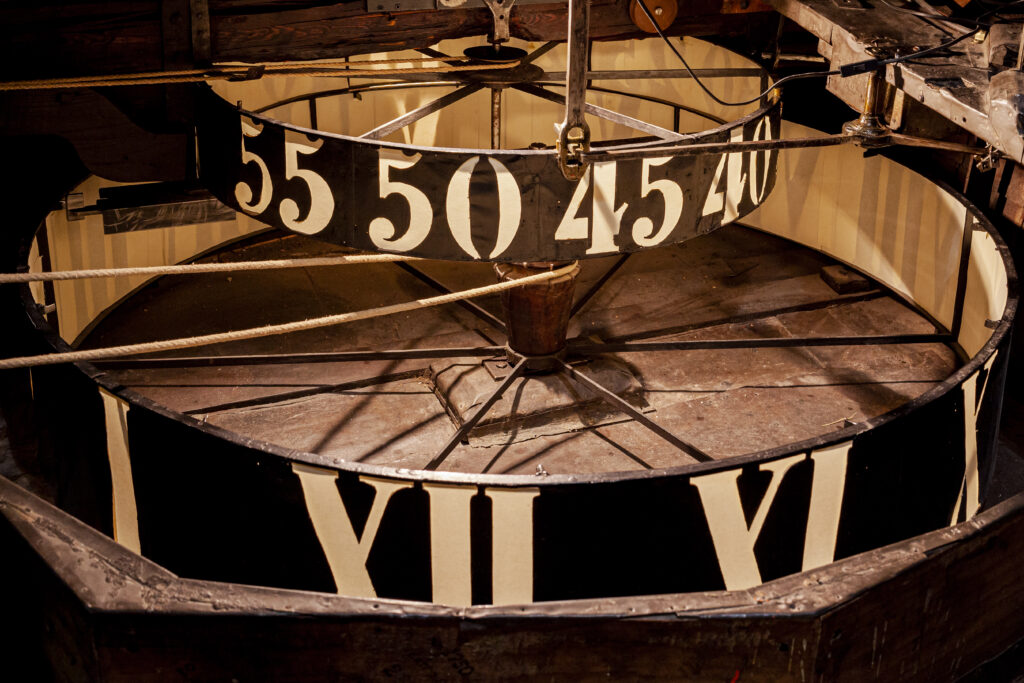
In mancanza di documenti espliciti, un cognome e un anno incisi sul telaio consegnano l’identità dell’artefice di questo ingegnoso manufatto: Antonio Barozzi, geometra e orologiaio nato a Sissa nel 1799 e morto a Parma nel 1870. Barozzi lo aveva approntato nel 1828, alcuni mesi prima dell’inaugurazione del Teatro nel maggio 1829, e il 27 di quello stesso mese fu assunto come orologiaio ufficiale del Teatro con il compenso di 120 lire annue per svolgere quanto previsto all’art. 151 del regolamento teatrale, cioè “obbligo di montare l’orologio della platea in tutte le sere di Teatro, accendendovi il lume occorrente ed anche senza lume nei giorni in cui sarà prova in Teatro”. Il meccanismo, semplicissimo, è quello di un orologio a pendolo. Alcuni pesi proporzionati alla resistenza delle ruote dentate trasmettono energia al sistema rotorio fino a innescare il movimento della ruota di scappamento, regolato da un’àncora uncinata che a sua volta trasmette il moto al pendolo, la cui oscillazione assicura frequenza costante al sistema. L’aspetto più affascinante riguarda però il modo con cui vengono attivati i due anelli che mostrano le cifre di minuti e ore. Si tratta di due grandi anelli neri, uno con le cifre dei minuti e uno sottostante di diametro maggiore con quelle delle ore, ricoperti all’interno da una striscia di pergamena e con dentini sporgenti sul lembo superiore alla sinistra di ogni numero. I numeri, ritagliati nell’anello nero, risultano perciò schermati solo dallo strato di carta, che permette di modulare la fonte luminosa posta al centro dell’anello inferiore, perciò dietro i numeri. Un braccio metallico aggancia una forchetta pendente dall’alto e si appoggia al dentino dell’anello superiore. Attraverso un sistema di corde, la risultante delle forze in gioco permette al braccio metallico di arretrare ogni cinque minuti, in modo da sganciarsi dalla forchetta, liberarsi dall’appoggio al perno e far scorrere in senso antiorario l’anello, per poi rientrare immediatamente bloccandosi al perno successivo, in modo da fermare la ruota all’altezza della nuova cifra oraria. Dalla platea si vede questa cifra dei minuti che, fermandosi, compie un piccolo rimbalzo: il rimbalzo del braccio metallico contro il dentino dell’anello. Terminato il giro dell’anello dei minuti, cioè dodici scatti, il sistema sblocca un secondo braccio a cancelletto, che muove a sua volta di uno scatto l’anellone sottostante che segna le ore grazie a un meccanismo analogo.
Arcano e impervio è il luogo dove è ospitato questo marchingegno cronografico a sedici metri di altezza, una stanzetta quadrangolare nella quale protagonisti sono decisamente i due grandi anelli con le cifre delle ore e i raccordi di funi che trasmettono i movimenti, mentre nascosto nell’ombra è il piccolo e semplicissimo meccanismo rotorio che alimenta tutto lo spettacolare sistema. Un nudo tavolino di legno con uno sgabello che fungeva, immaginiamo, da podio per raggiungere le parti superiori delle funi, completa questo anfratto collodiano. È una stanzetta – detto per inciso – che ha anche una fama di filtro d’amore, visto che leggenda d’epoca di Maria Luigia voleva che chi riuscisse a portare una donna fin qui e a baciarla, l’avrebbe fatta innamorare per sempre. Non è detto comunque che le firme datate graffi te sul muro siano quelle di altrettanti seduttori trionfanti. Va da sé che dalla platea il piacere dello sguardo a questo orologio è aumentato dall’eleganza dell’ornato, che si può dire gli conferisca una personalità, quel fare rassicurante che lo fa percepire dallo spettatore come un complice silenzioso e comprensivo delle serate teatrali. Purtroppo, in assenza di chiare documentazioni iconografi che sull’aspetto dell’architrave del palcoscenico nel progetto del teatro realizzato da Niccolò Bettoli del 1829, non è possibile valutare con esattezza l’ornato che evidenziava la mostra dell’orologio nel primo disegno neoclassico della sala, per quanto non sarà difficile immaginare che, in continuità alla snella decorazione di quel progetto, si sarà trattato di una sobria deviazione dalla sequenza di girali e palmette che percorrevano il fregio superiore sotto la vòlta. Ci pensarono Girolamo Magnani e Pier Luigi Montecchini nei rifacimenti degli ornati della platea del 1853 – quando ormai il Nuovo Teatro Ducale aveva assunto ufficialmente il nome di Teatro Regio – a fare dell’orologio l’elegante protagonista di quella sommità di palcoscenico: circondarono la mostra ovale di un fregio a cordoncino e lo inserirono in un regale cartiglio di legno dorato a quattro riccioli – che ricorda vagamente il giglio borbonico e si aggancia letteralmente all’architrave – da cui escono due frondose frasche fiorite. In questo modo l’orologio diventa non solo un oggetto di consultazione, ma anche un culmine visivo del boccascena. Non è detto che negli oltre quarant’anni durante i quali Barozzi fu sacrosanto e intoccabile titolare orologiaio del Regio, il che significa principalmente responsabile del manufatto e del suo funzionamento, abbia svolto costantemente in prima persona la manutenzione dell’orologio, ciò che incoraggiò gli incaricati temporanei a qualche ambizione. Accadde nel 1839, quando parve necessario installare un orologio anche all’interno del palcoscenico, a uso degli artisti e dei cantanti. Gesto di una schietta praticità, quasi severa, era questo non altro che l’orologio ora smontato e già posizionato sopra la porta che dà accesso al palcoscenico dalla prima fi la di palchi a sinistra, di cui resta un lacerto di meccanismo smembrato, proveniente dal vecchio Teatro Ducale nel Palazzo della Riserva. Giacché, naturalmente, un orologio esisteva dal XVIII secolo anche nel gloriosissimo Teatro Ducale che, prima della fondazione del Regio, fu accolto fino al 1829 nel Palazzo della Riserva, dove ora è la sede delle Poste centrali. Ovvio, a quel tempo la lunghezza degli spettacoli, le luci accese o semiaccese durante le opere, la fervida attività sociale fra i palchi durante le rappresentazioni, obbligavano la presenza di un orologio ben visibile, che nel nuovo Teatro, in età di spettacoli svolti sempre più spesso nell’oscurità o nella semioscurità, avrebbe assunto i discreti connotati della retroilluminazione. Non è chiaro perché a riparare e ripulire questo vecchio orologio del Teatro Ducale e a rimontarlo dentro il palcoscenico del nuovo Teatro fosse stato chiamato Pietro Veroni (1790-1878), dal 1824 al 1831 suonatore di timpano nell’orchestra del Teatro di Reggio Emilia (ma Veroni era di Parma). Probabile che le scarse entrate che procurava l’orchestra reggiana lo avessero spinto a riciclarsi come orologiaio, pur mantenendo il posto in orchestra. Fatto è che nel 1839 Veroni incassò 70 lire (ne aveva chieste 80) per il lavoro di riparazione e sistemazione di questo orologio dentro il palcoscenico, e un rifiuto alla richiesta di essere assunto come orologiaio del Teatro. In compenso l’anno dopo fu messo a libro paga come timpanista aspirante nell’Orchestra Ducale di Parma, dove rimase almeno fino al 1856, distinguendosi per l’invenzione del meccanismo di intonazione dei timpani con una sola vite. Un tipo sicuramente ingegnoso. Vale la pena parlarne perché la non chiara focalizzazione sull’identità del costruttore dell’orologio in platea, Barozzi, ha fatto supporre per molto tempo che i documenti su questo trasporto e riattamento dell’orologio del Ducale all’interno del palcoscenico del Regio si riferissero a quello della platea, dando a Veroni ciò che non era di Veroni. Questi aveva invece interamente ripristinato l’orologio del Ducale per l’uso interno al palcoscenico: un manufatto in ferro posto su un quadrante lucido con i numeri disegnati, di cui rifece molte parti e capovolse il meccanismo da verticale a orizzontale. Più che ai cantanti, serviva evidentemente al personale di scena e agli attori di prosa e dei numerosi spettacoli di arte varia, magia e meraviglie scientifiche che affollavano il palcoscenico nelle stagioni autunnali; alle serate di gala e alle feste durante le quali la platea, sgomberata dalle sedie (le poltroncine sarebbero arrivate molto più tardi), si trasformava in un’enorme sala da ballo; e comunque per garantirsi da qualsiasi disguido potesse insorgere con artisti più o meno inconsapevolmente ignari dell’orario che il pubblico, poco più in là, poteva controllare sull’orologio della platea. Un fatto, dunque: un omologo meno ingegnoso e meno elegante si occupava di riferire a chi lavorava in scena e dietro le quinte quanto l’orologio della platea comunicava placidamente al pubblico. Del resto, non c’è sempre chiarezza nei documenti ottocenteschi se la generica espressione “orologio del palcoscenico” riportata spesso nei pagamenti a Veroni per le manutenzioni si riferisca di volta in volta a quello interno al palcoscenico o a quello che, pur rivolto verso la platea, è posto comunque sull’architrave del palcoscenico stesso. Quanto a questo orologio della platea, il protagonista del nostro volumetto, la sua storia coincide d’ora in poi con la storia della sua manutenzione e delle riparazioni. Nel 1850, dietro suggerimento della commissione amministrativa del Teatro alla Presidenza delle Finanze ducale, sarà il figlio di Pietro Veroni, Giuseppe (nato il 2 febbraio 1817), ad essere nominato sostituto di Barozzi, senza compenso e con l’incarico di caricare tutti i giorni l’orologio del palcoscenico e sostituire Barozzi in caso di malattia, ruolo che mantenne per almeno una ventina d’anni riparando l’orologio certamente nel 1855 e nel 1863 e riuscendo ad accumulare un discreto patrimonio grazie alla sua attività di orologiaio. Ancora nel 1889 sono attestate riparazioni alle lettere, che avevano sofferto il surriscaldamento prodotto dall’illuminazione retrostante, e ulteriori riparazioni si ebbero più volte anche nel Novecento (l’ultima nel 1979). La cronaca recente, d’inizio millennio, è quella di un affaticamento del meccanismo che ne ha prodotto il collasso, fino a bloccarne il funzionamento per alcuni anni. Anni invero tristi, nei quali sembrava che l’orario comunicato dal Teatro, dal corpo stesso del Teatro, non ricoprisse più un ruolo affettivo e pratico per lo spettatore. La tecnologia da tasca aveva cominciato a fare il suo lavoro, e i numeretti elegantemente sagomati apparivano ai più il relitto di un mondo ormai inadoperabile, di cui si poteva fare tranquillamente a meno. Tanto più si avvertirà, adesso che ha ricominciato a funzionare, l’elegante utilità di uno strumento votato non a segnare il tempo ma ad isolarlo da altri possibili tempi così brutalmente banalizzanti, il tempo della fretta e del traffico in circonvallazione, quello lungo del lavoro e quello brevissimo del web, il tempo delle pause pranzo e delle partite. Dentro il teatro, invece, la sola dimensione reale è quella dello spettacolo nel quale si annullano tutte le altre percezioni, o sono falsate, o sono comunque destinate a convogliare nel quadrato del palcoscenico, sovrastato nell’ombra da un orologio dalla saggezza antica, che ignora la spasmodica ansia del minutaggio e accetta di raccontare una storia diversa, antica e immutabile, che si rivela solo a chi intuisce che il tempo in teatro è essere in teatro.